
The Miracle of Existence
by Adrianna Montes
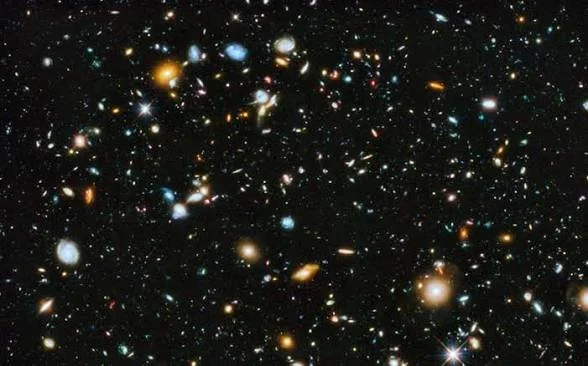
“Why is there something instead of nothing?” Rather than there being just a void of nothingness, there have been many little steps towards the creation of matter and ultimately humanity's existence, beginning with the Big Bang. With our ever-increasing scientific knowledge, we have been able to establish that we exist on a planet, in a solar system, in a galaxy, amongst an infinite number of galaxies that compose the never-ending universe. Considering this, don’t you wonder how we are, or even how maybe anything is?
Around 14 billion years ago, there was the Big Bang, the dominant theory of how everything began. Before this, there was a “time zero” where nothing existed. Stephen Hawking has written, “If the rate of expansion one second after the Big Bang had been smaller by one part in a hundred thousand million, it would have all re-collapsed.” Additionally, if the force of every atomic nucleus had been only slightly weaker or stronger, only the element hydrogen could exist and the universe would just be an endless bound of hydrogen. The early universe was an incredibly hot plasma (about 10^32 Kelvin - that’s 31 zeros after 10!), inhospitable to any kind of matter. As it rapidly expanded, the universe naturally cooled, allowing energy to finally condense into stable particles. With this cooling, matter began to coalesce, paving the way for the stars, planets, and galaxies we see today. The creation of the universe remains, in every sense, an incomprehensible marvel.
The formation of our solar system makes it perfect for the creation of life – perfect and, with a one in a trillion chance of existing, extraordinarily unique. Earth is precisely the right distance from the Sun. If we were too far, the planet would be so cold as to freeze all water, leading to most life dying. If we were too close, the planet would be too hot, melting and evaporating water. Earth is protected from solar radiation by its own magnetic field as well as it being kept warm by its own insulating atmosphere. And of course, it has the foundations for life: water and carbon.
Now, let's fast forward to the evolution of humans on the planet, since the incredibly low-probability existence of life in non-humanoid form has been established. The evolution of humans is astronomically low in the history of the formation of life. It requires billions and billions of years of intricately specific, repeating, random environmental and genetic events.
Maybe life is a combination of both the logical progression of the universe and pure luck. One could argue that life was all bound to happen, eventually becoming statistically inevitable over billions of years, but it was never inevitable that we would be here to experience it. Out of countless possibilities and the potential for it all to end at so many points in the timeline of the universe, the fact that we are here now to experience it is what makes us so extraordinarily lucky.
Selected sources for further exploration:
EarthSky: A bold new theory of intelligent life and origin of humanity
Penn State: Does planetary evolution favor human-like life?
Phys.org: Chance played a major role in keeping Earth fit for life