
Artemis: Journey Back to the Moon
by Jasper Gabrielsen, Ryan Imani and Riyan Khadka

The Artemis II mission began its lunar journey on April 1, 2026. This historic flight represented the first time a crewed mission has reached the Moon in more than 50 years. The mission's primary objective was to complete a full lunar flyby and return to Earth safely after roughly ten days. The four person crew consisted of NASA astronauts Reid Wiseman, Victor Glover, and Christina Koch, along with Canadian Space Agency astronaut Jeremy Hansen. Victor Glover became the first person of color and Christina Koch became the first woman to travel into low earth orbit. To prepare for the flight, the crew underwent three years of intensive training. While earlier 2017 plans for Exploration Mission-2 (the mission's former name) involved using a Space Launch System Block 1B rocket to rendezvous with an asteroid, the mission ultimately focused on a direct lunar flyby using the SLS and Orion spacecraft. During the mission they set the record for human distance from Earth, reaching a maximum distance of approximately 252,000 miles, or 407,000 km, from Earth.
NASA’s overall mission is to prepare for sustainable lunar exploration and future Mars missions by testing human performance and spacecraft operation in lunar space. Artemis II and the upcoming Artemis III are a bridge to Artemis III, which is a mission to deliver humans to the surface of the Moon for the first time in over 50 years. Artemis II was also a critical testing and launch pad for the life support systems needed to operate for extended periods of time in orbit or in the vacuum of space. AVATAR (an acronym for A Virtual Astronaut Tissue Analog Response) are thumb-sized organ chips containing human marrow cells that are used to study the effects of deep space radiation and microgravity. The results of this experiment confirmed scientists’ hypotheses that deep space radiation can lead to harmful mutations during DNA replication in human marrow cells. These results will need to be considered in the future as humans begin living for longer periods in space. For more info on the Artemis science experiments, click here

Artemis II NASA astronauts (left to right) Reid Wiseman, Victor Glover, and Christina Koch, and CSA (Canadian Space Agency) astronaut Jeremy Hansen
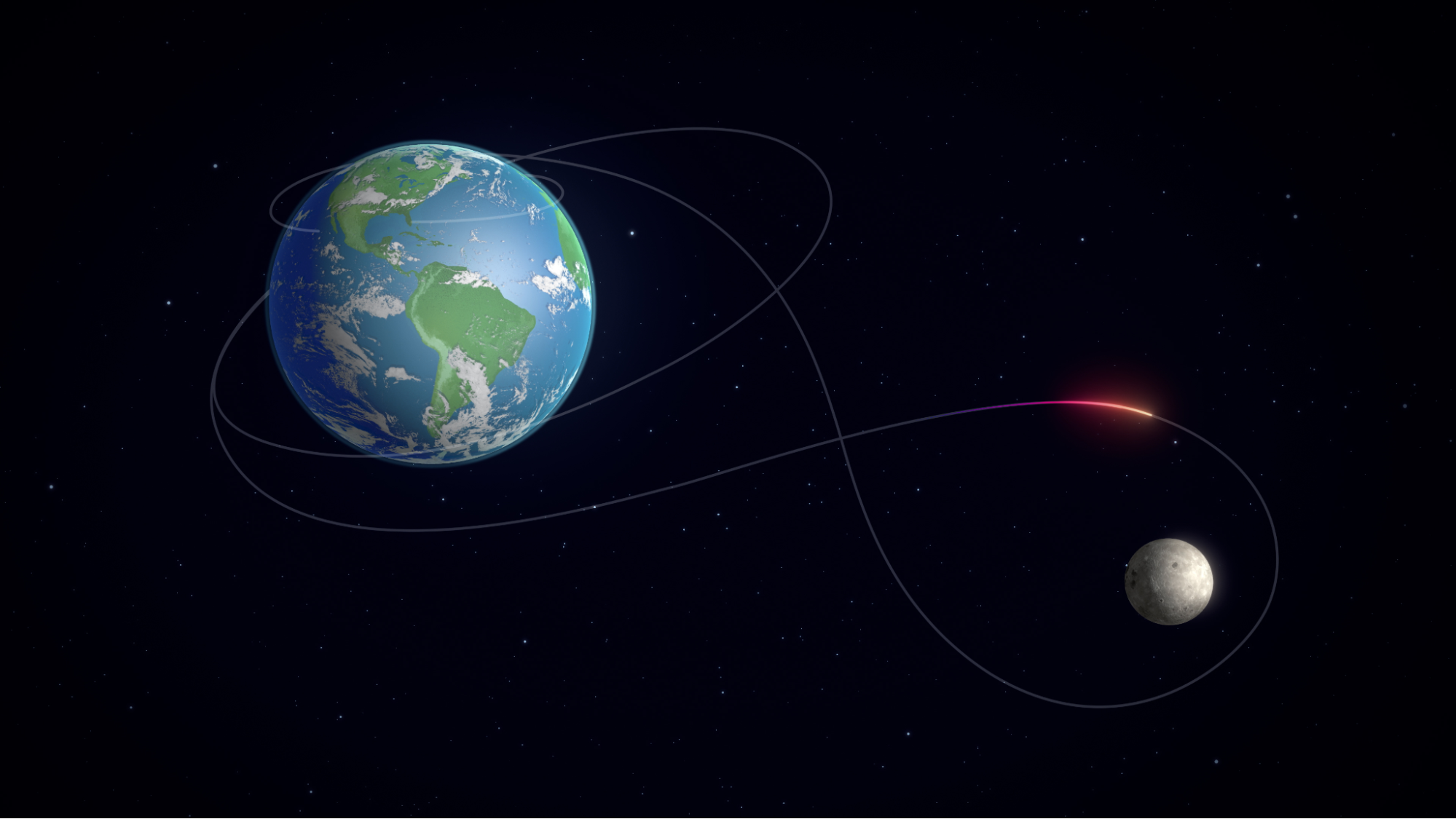
Artemis II flight path
The journey home concluded on April 10, 2026, when the Orion spacecraft, nicknamed Integrity, reentered Earth's atmosphere at speeds exceeding 24,600 mph. To manage the intense friction and 5,000F temperatures, the capsule performed a skip entry maneuver, which means that it momentarily bounced off the Earth’s upper atmosphere to bleed off energy before its final descent. Following a planned six-minute communications blackout caused by ionized plasma blockage, the spacecraft successfully deployed a sequence of parachutes that slowed its fall to approximately 17 mph. The mission ended with a precise splashdown in the Pacific Ocean off the coast of San Diego at 5:07 p.m. PDT. A combined recovery team from NASA and the U.S. Navy quickly retrieved the crew by helicopter and transported them to the USS John P. Murtha for medical evaluation before their final return to Houston.
By setting a new record for human distance from Earth, the mission validated the Orion spacecraft and the SLS rocket as the backbone for a permanent lunar settlement. Looking ahead, NASA has accelerated its timeline to establish a “moon base.” The next phase, Artemis III, is targeted for late 2027 as an Earth orbit mission to test docking with commercial landers like SpaceX's Starship, followed by the Artemis IV mission in early 2028, which aims to land the first astronauts at the lunar South Pole.

Illustration of a potential Moon Base
Inside Artemis
by Riyan Khadka
The Artemis program is a series of missions that are planned to end in a semi-permanent site on the Moon. There have currently been two missions: Artemis I, an unmanned mission around the Moon in 2022, and Artemis II, a manned mission which recently completed a figure 8 path around the Earth and Moon. But why are we doing them? NASA is planning to go to Mars in the future, so they need a location in between in order to make that happen. The Moon is that place.
The Moon will act as a stepping stone to get there, so the Artemis missions’ final goal is to get humans back on the Moon and to prolong our ability to remain there. Artemis IV is planned to happen in early 2028, which will be a lunar South Pole landing where the first woman and first person of colour will step on the surface. Click here for more info on Artemis IV.
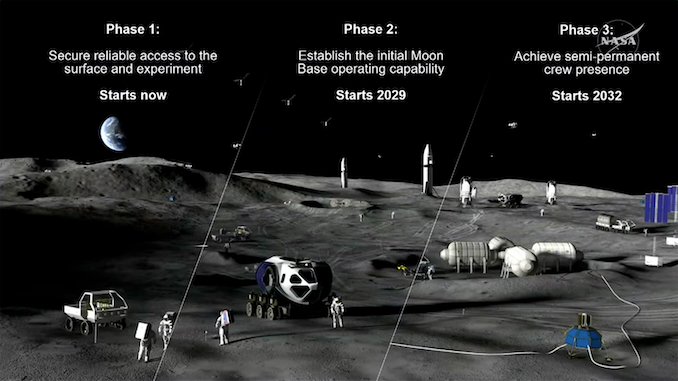
These missions will help build Artemis Base Camp, a concept where humans can stay on the Moon for weeks or even months at a time, according to NASA’s News Chief Cheryl Warner in the article Lunar Living: NASA’s Artemis Base Camp Concept: “To give astronauts a place to live and work on the Moon, the agency’s Artemis Base Camp concept includes a modern lunar cabin, a rover and even a mobile home. Early missions will include short surface stays, but as the base camp evolves, the goal is to allow crew to stay at the lunar surface for up to two months at a time.” The plan includes small-scale farms to sustain life and other life support for the astronauts. If this idea becomes a reality, it would be an important site for testing the viability of manned missions to the surface of Mars, as well as potentially other planets or moons.
The historic mission of Artemis II came back with 7,000 photos, including the “Earthset” image, a stunning photo of the Earth dropping beneath the lunar horizon, which was possible because for the first time, humans traveled behind the “dark side” of the Moon. In fact, when the moon blocked their view of the sun, they even experienced a 51 minute-long solar eclipse. This photo echoes the famous “Earthrise” taken in 1968 by Apollo 8.

Earthset, taken by astronaut Christina Koch on April 6, 2026
The Artemis crew also photographed geologic features on the surface on the Moon in collaboration with a team of scientists back on Earth in real-time. These photos are being analysed by scientists to refine their knowledge of the Moon’s landmarks and were cross-referenced with the spacecraft’s location and photos from amateur astronomers. Jacob Bleacher, NASA’s chief exploration scientist at the headquarters, said, “Now that higher resolution images are coming down, we can finally experience the moments they were trying to share and truly appreciate the scientific return provided by these images and our other research on this mission.” The success of Artemis II has truly shown us what we are capable of. Onward to more explorations!
