
by Calvin Dae
Voyager 1 was launched by NASA on September 5, 1977 and was originally designed for a 5-year mission to explore Jupiter and Saturn. But due to its excellent construction, a durable energy source, and some successful problem-solving, this probe has continued to operate. On November 18, 2026, it will reach one light-day from Earth and be widely celebrated at JPL and around the world. One light-day is about 16 billion miles, which is the distance light can travel in one day. Voyager 1 and its twin, Voyager 2, launched on August 20, 1977, and they have reached many milestones, one of the most famous being the “pale blue dot” photo. How has it lasted almost 50 years and almost 16 billion miles without malfunctioning?
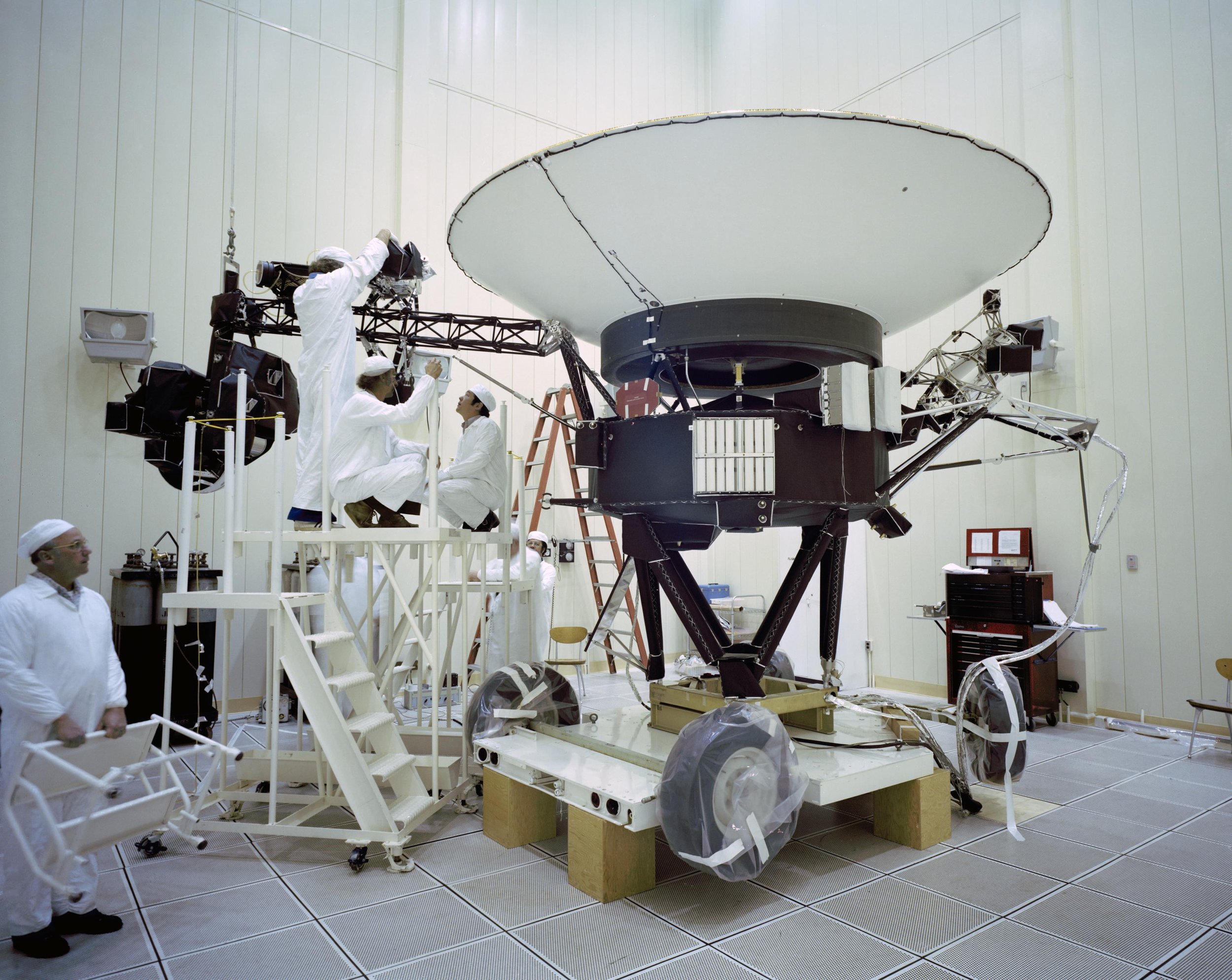
NASA engineers prepare Voyager 2 spacecraft in March, 1977
Voyager 1 has now reached interstellar space, which is the part of space past the heliopause, where the solar wind meets the interstellar medium. In fact, it is officially the farthest man-made object in space from Earth. The genesis of Voyager 1 started in 1965 when scientists noticed a rare alignment that would happen in the late 1970s and would allow a mission to explore all four outer planets–Jupiter, Saturn, Uranus, Neptune--with minimal course adjustment.
On its way to this planetary mission, Voyager 1 has made a lot of discoveries while exploring Jupiter and Saturn. Voyager 1 discovered a new Jovian ring and two new moons that were named Thebe and Metis. At Saturn, Voyager 1 found five new moons: Atlas, Prometheus, Pandora, Epimetheus and Helena, and a new ring called the G-ring.
The Voyager Interstellar Mission (VIM), which combines Voyagers 1 and 2 , began on January 1, 1990 and has had many accomplishments. On February 17, 1998, Voyager 1 overtook Pioneer 10 as the farthest man-made object in space. Then on December 16, 2004, it passed the termination shock, where the solar wind slows down from hypersonic speeds (anything above 5x the speed of sound) to sub-supersonic speeds (below the speed of sound). Voyager 1 reached interstellar space on August 25, 2012 while moving at a speed of 38,000 mph.
Even though its twin, Voyager 2, claimed the record for the longest-active space probe on August 13, 2012, formerly held by Pioneer 6, Voyager 1 achieved the record for the second-longest active space probe on August 29, 2012. Just four days earlier, on August 25, 2012, Voyager 1 became the first man-made object in interstellar space, while Voyager 2 reached interstellar space on November 5, 2018.
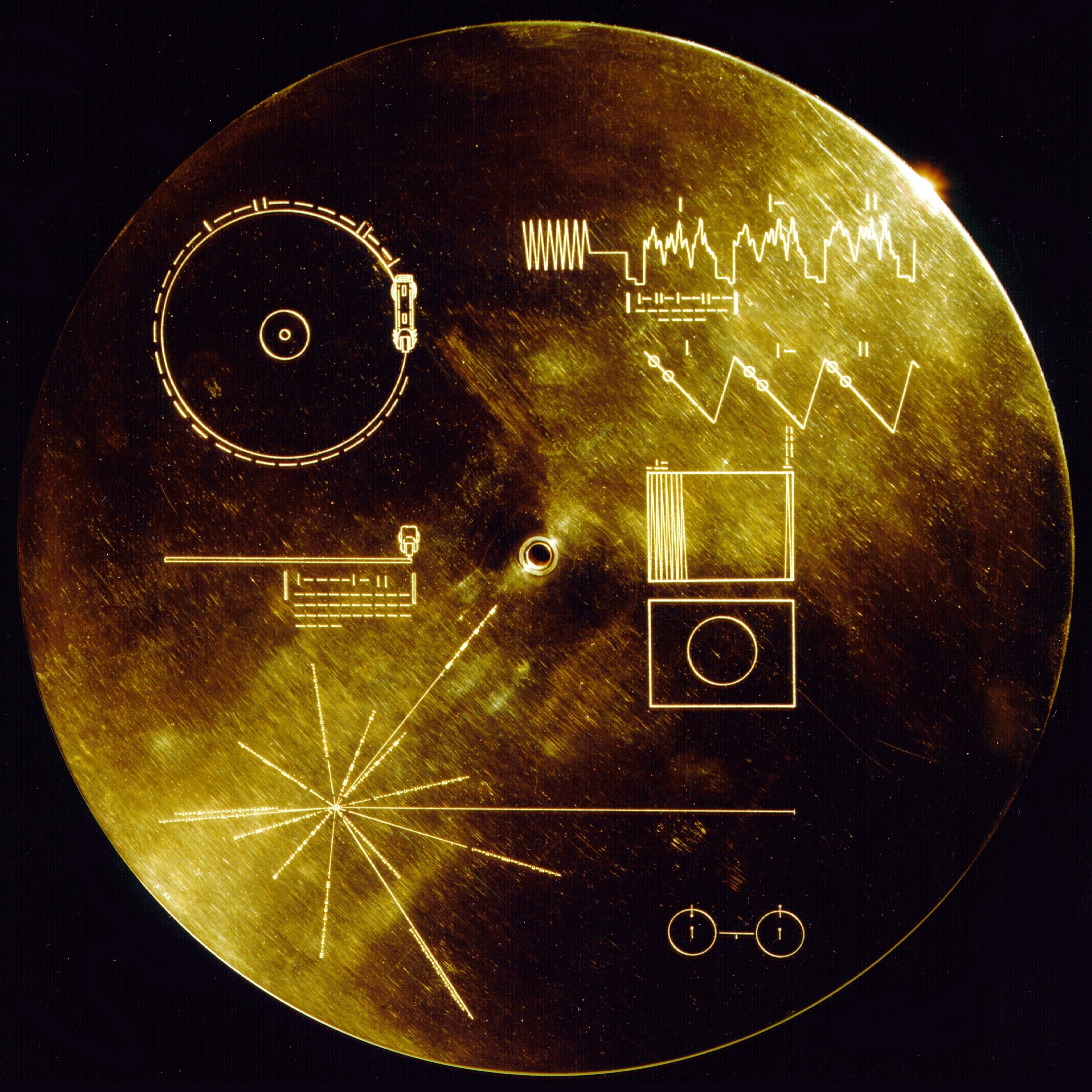
Voyager’s Golden Record
Voyagers 1 and 2 are famous for the “golden record” they both carry, designed in the chance that one of the Voyagers would encounter extraterrestrial life. On the bottom left of the cover, there is a diagram showing the position of the sun relative to 14 pulsars, and each of their pulsation periods is written in binary code. On the bottom right of the cover, there is a diagram describing the two lowest states of a single hydrogen atom, since the transition time between these states is what is used for a measurement of time on the rest of the record. On the top left of the cover, written in binary, is the speed that the record is meant to be played at and a model of where to place the parts provided by the record that make it playable, in addition to a side view of the record and the length of time it takes to finish one side of the record. On the top right of the cover, the diagrams show the video portion of the recording. The golden record itself contains 115 images, a variety of natural sounds and music, greetings in 55 languages and messages from the then US president Jimmy Carter and the secretary of the United Nations.
Thanks to a recent maneuver by engineers nicknamed “the Big Bang,” which involves swapping heaters and instruments with lower power alternatives, NASA has successfully extended the lifespan of Voyager 2 to around 2036, just months after Voyager 1’s lifespan will end if the “the Big Bang” maneuver goes well. Proposed follow-up missions are still being evaluated, but the one that has received the most attention is the Interstellar Probe (ISP). The ISP launch is targeted between 2036 and 2041, and the probe, nicknamed “Voyager on Steroids,” would use a Jupiter gravity assist to reach interstellar space in just 16 years, a massive improvement from both of the Voyagers. Voyager 1 reached interstellar space in 34 years and 355 days, while Voyager 2 took 41 years and 77 days. Ultimately, Voyager is an inspiring example of human curiosity and determination. For more information, check out NASA’s Interstellar Mission website